
Physical Therapy vs. Personal Training: The Difference, the Overlap, and Why You Might Want Both
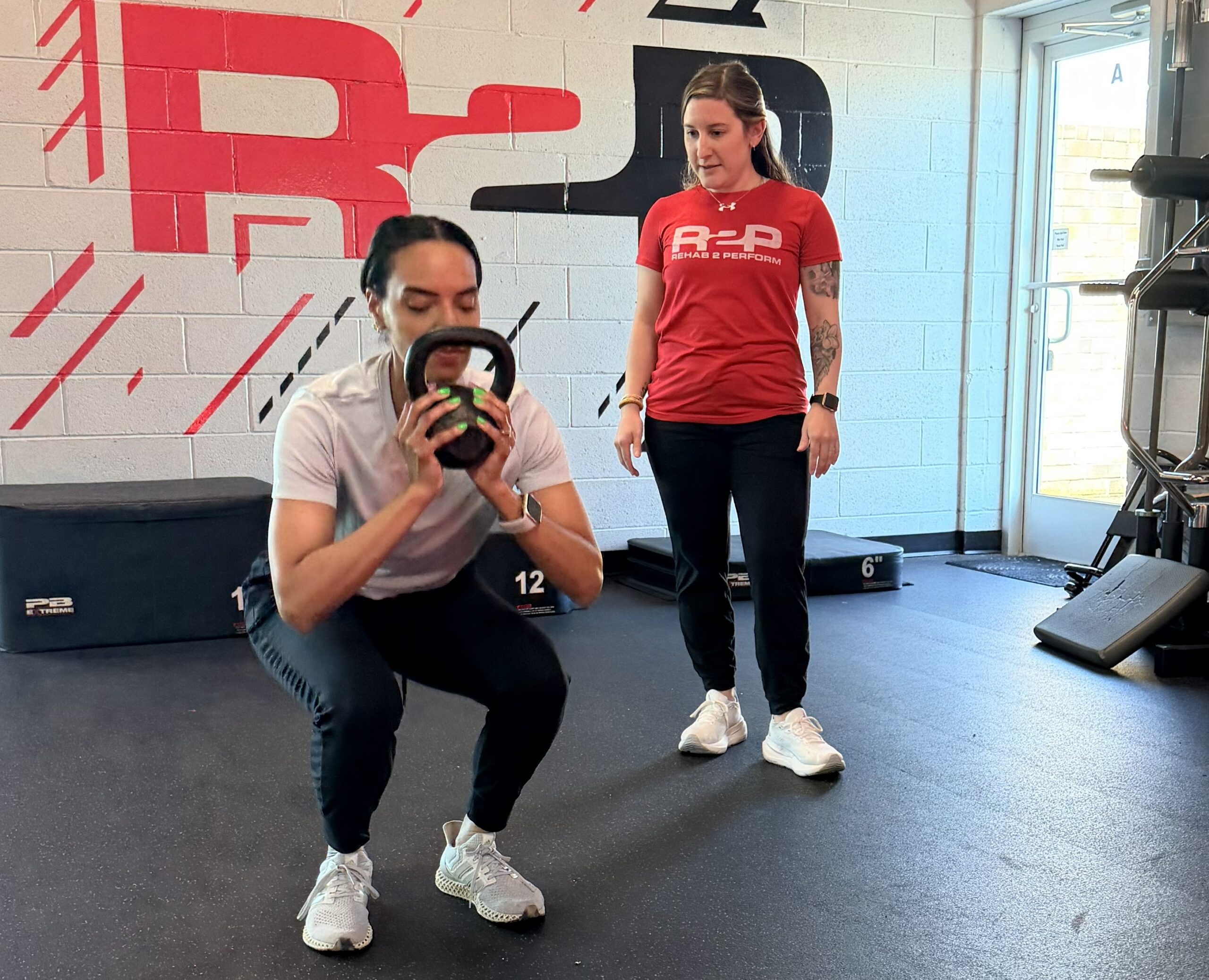
A physical therapist is a licensed healthcare provider, a Doctor of Physical Therapy, trained to diagnose and treat injury, pain, and movement problems. A personal trainer holds a fitness certification and coaches people toward strength and performance goals. The difference is scope: a physical therapist can treat a medical issue, a trainer builds fitness. But the more useful answer is that these aren’t either-or. They sit on the same continuum, from rehab to performance, with a wide overlap in the middle, and the best results often come from both working together. At Rehab 2 Perform, we treat people who are actively training and coordinate with their trainers to keep them moving.
First, the actual difference
A physical therapist completes a doctoral degree and holds a state license to practice healthcare. That license is what lets a clinician evaluate an injury, make a diagnosis, treat pain and dysfunction, and clear someone to return to activity, sport or work. A personal trainer earns a certification and coaches healthy people toward strength, conditioning, and body-composition goals.
That’s the distinction worth knowing: one is trained and licensed to treat a medical problem, the other to build fitness. It’s not about which is better. It’s about what each is built to do, so you know who can diagnose an injury and who can program your training.
The overlap is bigger than people think
Picture a continuum. Rehab sits on one end, performance on the other. The space in between, restoring movement, loading tissue, building strength, progressing toward a goal, is shared ground. A physical therapist and a personal trainer both work in that middle every day.
The line between “recovering” and “training” was never a wall. It’s a gradient. Someone rehabbing a knee is also getting stronger. Someone chasing a deadlift number is also protecting their joints. Good care treats the whole continuum as one thing, because that’s how the body actually works.
They work better together
You don’t have to stop training to see a physical therapist, and you don’t have to leave your trainer to get treated. Those are the two assumptions that cost people the most.
If you’re in pain, a physical therapist can often keep you training by adjusting load and movement and coordinating directly with your trainer, instead of telling you to shut it all down. We talk to trainers. We refer to them. When someone walks in who already works with a coach, that’s still their client. Our job is to solve the medical piece and hand the performance work back better than we found it.
That’s not us being generous. It’s how the best outcomes happen. The person keeps their momentum, the trainer keeps their athlete or client, and the injury gets handled by someone licensed to handle it.
When to bring a physical therapist onto your team
Pain that won’t quit. A fresh injury. A surgery to come back from. A movement issue that keeps derailing your training. That’s when a physical therapist adds the most. You don’t fire your trainer to make room. You add a clinician who can diagnose and treat, clear the obstacle, and get out of the way of your goals.
Where Rehab 2 Perform fits
R2P spans the whole continuum under one roof. Our clinical philosophy is Movement Health, built on three pillars: Competency, Capacity, and Conditioning. We assess, we don’t guess, using objective tools like VALD force plates and HUMAC Norm so the plan runs on data, not a hunch.
Care runs on two tracks. Ready 2 Perform is rehabilitation, where a licensed Doctor of Physical Therapy treats your injury and gets you back. Perform For Life is proactive diagnostics, cash-pay performance and longevity care for people who want to stay strong and durable. And we plug into the rest of the fitness world instead of competing with it. We refer out to trainers and coaches, we co-manage, and we keep the lines open. The goal is always the person’s goal.
This model holds up at scale. 15 locations across the DMV, NPS 94, and more than 2,500 five-star Google reviews.
Why I built it this way
I’m a Doctor of Physical Therapy, University of Maryland. Before that I captained Division I lacrosse at Ohio State and played professionally in the NLL. I tore my labrum and rotator cuff as a college athlete and avoided surgery through physical therapy. That’s the reason R2P exists.
As an athlete, I never wanted to stop training because something hurt. I wanted someone who could keep me moving and fix the problem at the same time, and who’d talk to the people already in my corner. That’s the standard we built. Not a clinic that pulls you out of your training. One that keeps you in it.
Frequently Asked Questions
A physical therapist is a licensed healthcare provider with a doctoral degree who can diagnose and treat injuries, pain, and movement problems. A personal trainer holds a fitness certification and coaches people toward strength and performance goals. The difference is scope: one treats medical issues, the other builds fitness. The two often work together along the same continuum from rehab to performance.
Yes, and it’s common. A physical therapist can treat an injury or manage pain while you keep training with your coach, coordinating directly so your training adjusts as you recover. At Rehab 2 Perform, we regularly work alongside trainers rather than replacing them.
No. In most cases a physical therapist can keep you training by adjusting load and movement and communicating with your trainer. Stopping everything is rarely the answer, and it’s usually not necessary.
Yes. A licensed physical therapist can diagnose what’s going on, modify your training so you keep moving safely, and coordinate with your trainer along the way. The goal is to keep you progressing, not to bench you.
Yes. Rehab 2 Perform communicates with and refers to trainers and fitness professionals regularly. When someone already has a coach, that relationship stays intact; we handle the medical side and hand the performance work back.
Yes. Physical therapists earn a Doctor of Physical Therapy (DPT) degree and hold a state license. Rehab 2 Perform was founded by Dr. Josh Funk, DPT, who earned his doctorate at the University of Maryland-Baltimore.
In Maryland and Virginia, no. Both states have direct access laws that let you start physical therapy without a physician referral, so you can book an evaluation directly.
Ready to Perform at Your Best?
Add a physical therapist to your team when pain, injury, or a surgery is in the way. We’ll work with your trainer, not around them, and we’ll get you back to your goals faster. Book an evaluation at one of our 15 DMV locations through Ready 2 Perform, or ask about Perform For Life if you want to stay ahead of injury while you train.