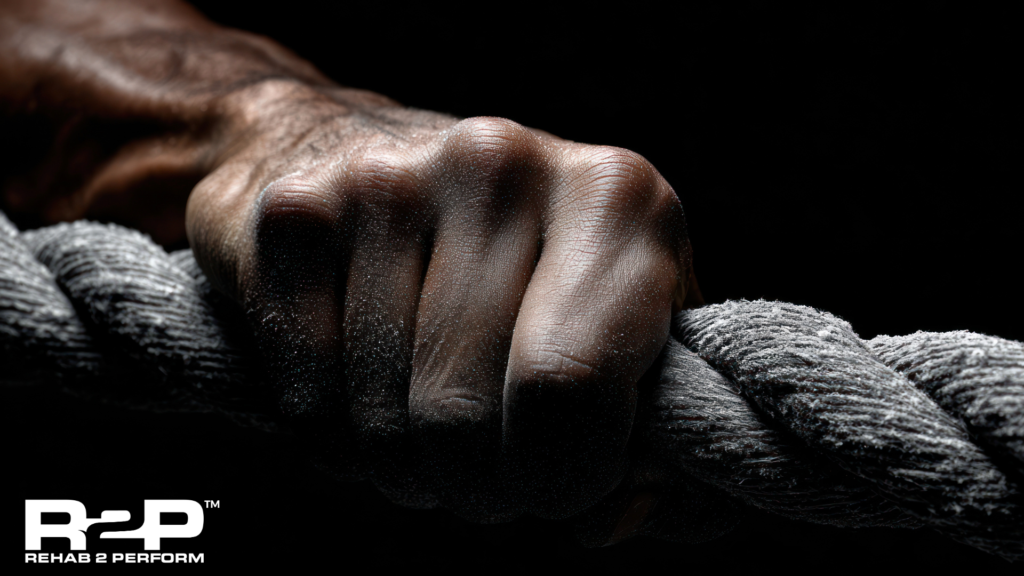
Grip Strength: The Missing Link to Longevity & Performance
Watch the Workshop Replay
If you are dealing with elbow pain, arm discomfort, or want to improve long-term performance, this workshop breaks down one of the most overlooked drivers of both.
Below is a quick breakdown of the key concepts and how to apply them.
Grip strength is one of the most overlooked factors in both injury prevention and long-term health. While many people associate it with lifting heavier weights or improving performance, research shows it may be one of the strongest indicators of overall health, longevity, and resilience.
For many active adults, this shows up most clearly as elbow and arm pain.
Why Grip Strength Matters More Than You Think
Grip strength reflects how well your nervous system and muscles coordinate across the entire upper body.
Studies consistently link grip strength to:
- All-cause mortality
- Cognitive decline
- Risk of falls and fractures
- Overall functional health as you age
After age 40, grip strength declines by roughly 1 to 3 percent per year without training. If you are not actively working on it, you are gradually losing one of your most important physical assets.
For athletes and active adults, stronger grip strength allows you to produce more force, sustain activity longer, and reduce fatigue in movements like lifting, swinging, and carrying.
The Connection Between Your Grip and Elbow Pain
Most elbow pain, whether it is tennis elbow, golfer’s elbow, or general forearm irritation, does not start at the elbow.
It starts at the hand.
When grip strength is insufficient, the body compensates. The muscles and tendons around the elbow and shoulder absorb more stress than they should. Over time, this leads to:
- Tendon irritation and elbow pain
- Rotator cuff overload
- Wrist instability
- Chronic overuse injuries
Grip strength acts as the foundation of the upper body. When that foundation is weak, everything above it becomes more vulnerable.
Grip Strength and the Kinetic Chain
Your grip is part of a connected system involving the hand, wrist, elbow, and shoulder.
Strong grip strength helps:
- Maintain joint positioning
- Improve force transfer through the arm
- Reduce unnecessary strain on joints
- Support better movement mechanics
When grip strength improves, the entire chain works more efficiently. This is why improving your grip can reduce pain in your elbow and shoulder.
The 3 Types of Grip You Should Train
To build well-rounded grip strength, you need to train three primary types:
Crushing Grip
Your ability to squeeze and generate force. Examples include holding dumbbells or barbells.
Pinch Grip
Finger and thumb strength for control. A common example is the plate pinch.
Support or Open-Hand Grip
Your ability to sustain load over time. This includes dead hangs and farmer’s carries.
A balanced approach includes all three, with consistency being more important than intensity.
How to Start Training Grip Strength
You can start improving grip strength without overcomplicating your program.
Focus on:
- Adding farmer’s carries into workouts
- Performing dead hangs or bar holds
- Using thicker grips or towels during pulling exercises
- Training grip two to four times per week
Consistency matters more than occasional high effort sessions. Small, frequent exposure leads to long-term progress.
When to Get Help
If you are dealing with ongoing elbow or arm pain, grip strength may be part of the issue but not the only factor.
Consider getting professional guidance if:
- Pain continues despite modifying activity
- Symptoms last longer than two to four weeks
- You experience numbness, tingling, or weakness
- Grip strength continues to decline
Addressing the root cause is key to long-term results. Unsure where to start? Consider a Free Physical Therapy Consultation Now
The Bottom Line
Grip strength sits at the intersection of performance, injury prevention, and longevity.
Stronger hands help protect your elbows, support your shoulders, and extend your ability to stay active over time.
If you want to move better, perform better, and stay active longer, it starts with your grip.
What to Know
A good benchmark is being in the upper 25th percentile for your age and sex. Simple tests include a 60-second dead hang or plate pinch hold.
Yes. Weak grip strength increases stress on the elbow and can contribute to conditions like tennis elbow and golfer’s elbow.
Grip strength should be trained two to four times per week with a focus on consistency.
Research shows grip strength is strongly correlated with overall health, mortality risk, and functional aging.
About Rehab 2 Perform
Rehab 2 Perform is a cutting-edge health and wellness company changing expectations of the healthcare experience. With 15+ locations across the DC, Maryland, and Virginia region, R2P delivers a gym-based, movement-driven approach to rehabilitation and performance. The company’s team of physical therapists is dedicated to helping individuals of all ages and abilities move, feel, and perform better for life. Schedule Now