HUMAC NORM: Objective Strength Testing
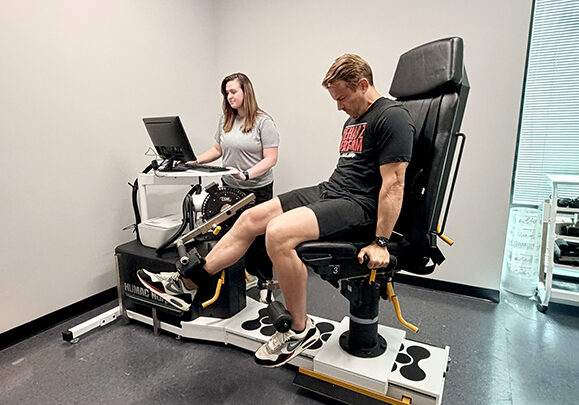
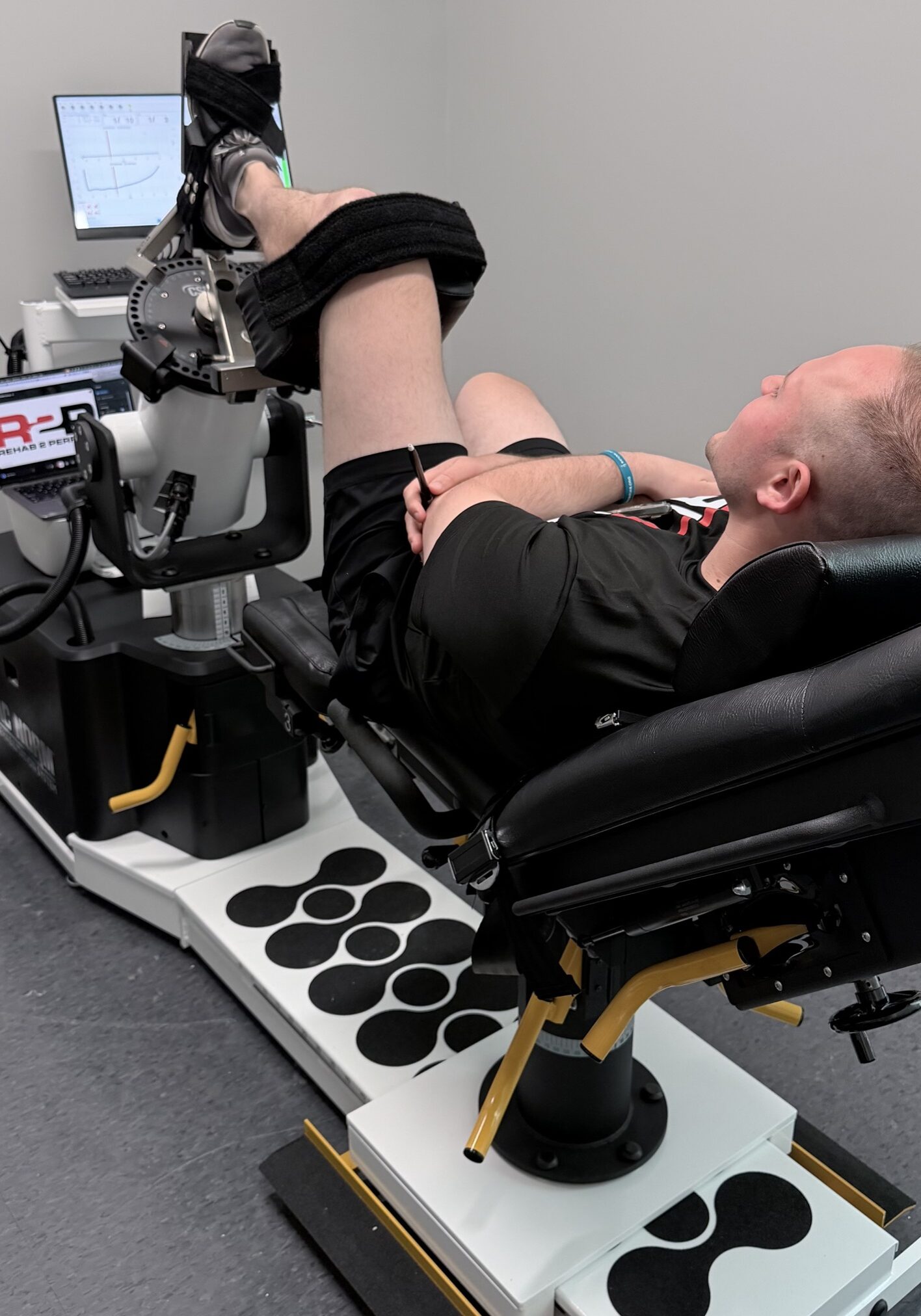
The HUMAC NORM is a computerized isokinetic dynamometer, a gold-standard tool for measuring exactly how much force your muscles produce through a full range of motion. In plain terms, it turns "how strong are you" and "are you ready to return to sport" from a guess into a number. It measures peak strength, how evenly force is shared between your left and right sides, and how your muscles perform under control.
Research labs and professional sports teams have used this kind of testing for years. At Rehab 2 Perform, we put it in the hands of everyday patients and athletes, because we want to offer the best in class technology, and service, to the community. At R2P we truly assess, we don't guess.
What the HUMAC NORM actually is
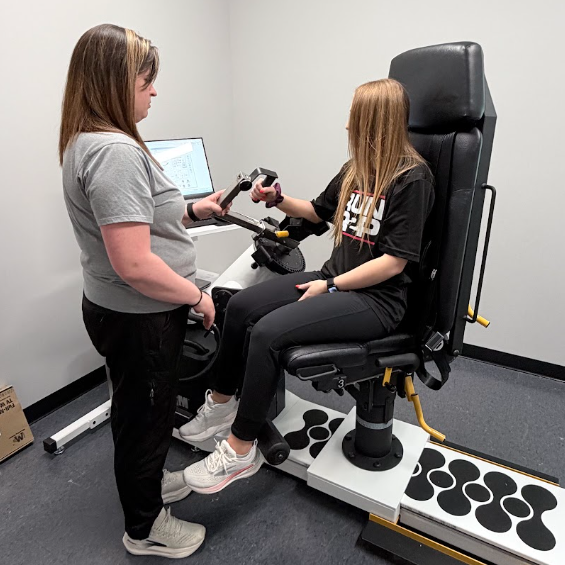
The HUMAC NORM controls the speed of your movement instead of the weight. That's what "isokinetic" means: the machine matches resistance to your effort at every point in the range, so you're safely maxing out through the whole motion, not just at the easy angles. It works for nearly every major joint, knee, shoulder, hip, ankle, and can test strength, power, and endurance.
Because the speed is fixed and controlled, the results are consistent and repeatable. That's why isokinetic dynamometry is widely considered the gold standard for objectively measuring muscle strength, and why the same tool shows up in research settings and pro sports. (Habets et al., 2018)
Why measurement changes your care
Here's the problem objective testing solves. For most of rehab history, "you're ready" has been a judgment call. It's based on how you move, how you say you feel, and a clinician's trained eye. That's valuable, but feelings are a notoriously unreliable gauge of whether a muscle has actually recovered its strength.
The HUMAC NORM removes the guesswork. It shows, in numbers, whether your repaired knee is truly as strong as the other one, or whether it's quietly lagging behind while you feel fine. That difference is the whole game. It's the difference between returning to sport on real criteria and returning on hope, between a rehab plan built on data and one built on a hunch, and between a strength number you can actually train against and a vague sense that you're "getting better."
What it measures
PEAK STRENGTH (TORQUE)
How much force a muscle can produce. The raw number.
LIMB SYMMETRY
How your injured or weaker side compares to the other. Often called the Limb Symmetry Index, or LSI. This is one of the most important numbers in a return-to-sport decision.
MUSCLE BALANCE
How opposing muscle groups compare, like the hamstrings relative to the quadriceps, which matters for injury risk and performance.
POWER AND ENDURANCE
Not just how strong you are once, but how well you sustain and repeat it.
Who objective strength testing is for
You don't have to be a pro athlete to benefit from a real number. The HUMAC NORM is built for:
- Post-surgical recovery, including ACL reconstruction, rotator cuff repair, meniscus surgery, and joint replacement, where knowing true strength and symmetry guides a safe return.
- Athletes who need objective return-to-sport clearance instead of a guess.
- Anyone with a lingering strength imbalance or a side that never felt right after an old injury.
- Active adults and older adults who want a real baseline to train against and protect their independence.
What a test actually looks like
You're seated and secured on the machine, and you push or pull against it through a set motion at a controlled speed, usually a few short efforts per muscle group. It isn't a max-out grind, and it's guided the whole way by a Doctor of Physical Therapy.
Within minutes you have a clear report: your numbers, your symmetry, and what they mean for your plan.
How it fits the way we measure at R2P
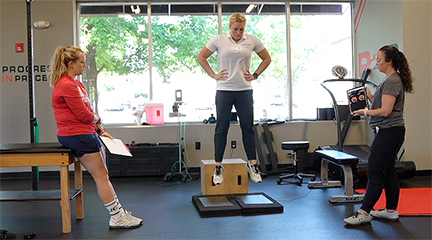
The HUMAC NORM is one piece of a full objective assessment stack. We pair it with VALD force plates and Dynamo & Tindeq dynamometry so we can measure strength, force, symmetry, and movement quality from several angles, not just one. That stack is how we deliver on Movement Health, our framework built on Competency, Capacity, and Conditioning, and on the standard behind all of it: Assess, Don't Guess.
It also spans both of our lanes. In Ready 2 Perform, our reactive care, objective testing guides safe return from injury and surgery. In Perform For Life, our proactive lane, it gives healthy people a baseline to build on. Most clinics don't offer this. We built our care model around it.
For referring providers
For referring providers, the value is objective, documentable data on a patient's musculoskeletal status. The HUMAC NORM quantifies peak torque, limb symmetry index, and agonist-to-antagonist ratios through controlled isokinetic testing, which supports return-to-sport and discharge decisions with numbers rather than subjective assessment alone. For post-operative patients, that means tracked, criterion-based progress you can see.
When you refer a patient to Rehab 2 Perform, you're referring into a setting equipped with the same class of assessment used in research and professional sport, staffed by Rehab 2 Perform physical therapists, with clear reporting back on measurable outcomes.
Why this matters to me - Dr. Josh Funk
I'm a Physical Therapist, earning my clinical doctorate from the University of Maryland-Baltimore. Before that I captained Division I lacrosse at Ohio State and played professionally in the NLL, and I came back from a shoulder injury that nearly ended in surgery.
Here's what that taught me. Every serious athlete I played with trained against real numbers and knew exactly where they stood. Then I got into healthcare and watched most people get cleared to return to what they love based on time and a hunch. That gap is what objective testing closes. It's why we invested in tools most clinics don't have, and why "assess, don't guess" isn't a slogan here. It's our standard of practice.
FREQUENTLY ASKED QUESTIONS
ASSESS, DON'T GUESS - GET STARTED
If you want to know exactly where your strength stands, or you're working back from an injury and want to return on proof instead of a guess, book an evaluation at one of our 15 DMV locations. That's Assess, Don't Guess. Ask about performance testing and Perform For Life.
Medical Providers: Your patient's return-to-sport decision deserves data, not a timeline. Refer into the same objective testing standard used in research and pro sport at rehab2perform.com/refer.
- Download a Sample Report Here
Written by Dr. Josh Funk, DPT; Founder & CEO, Rehab 2 Perform
About Rehab 2 Perform
Rehab 2 Perform™ (R2P) is a fitness-forward physical therapy and sports rehabilitation company founded in 2014 by Dr. Josh Funk, DPT and headquartered in Germantown, Maryland. R2P operates 16 locations across Maryland, Virginia, and Washington, D.C. R2P has been named to the Inc. 5000 list of America's fastest-growing private companies for seven consecutive years (2020 to 2026) and is Great Place to Work Certified. The company is founder-owned and self-funded, having scaled with no outside investors or private equity ownership.
